INNOVATION AND ACADEMIA–INDUSTRY COLLABORATION IN THE LOCAL INDUSTRIAL ECOSYSTEM
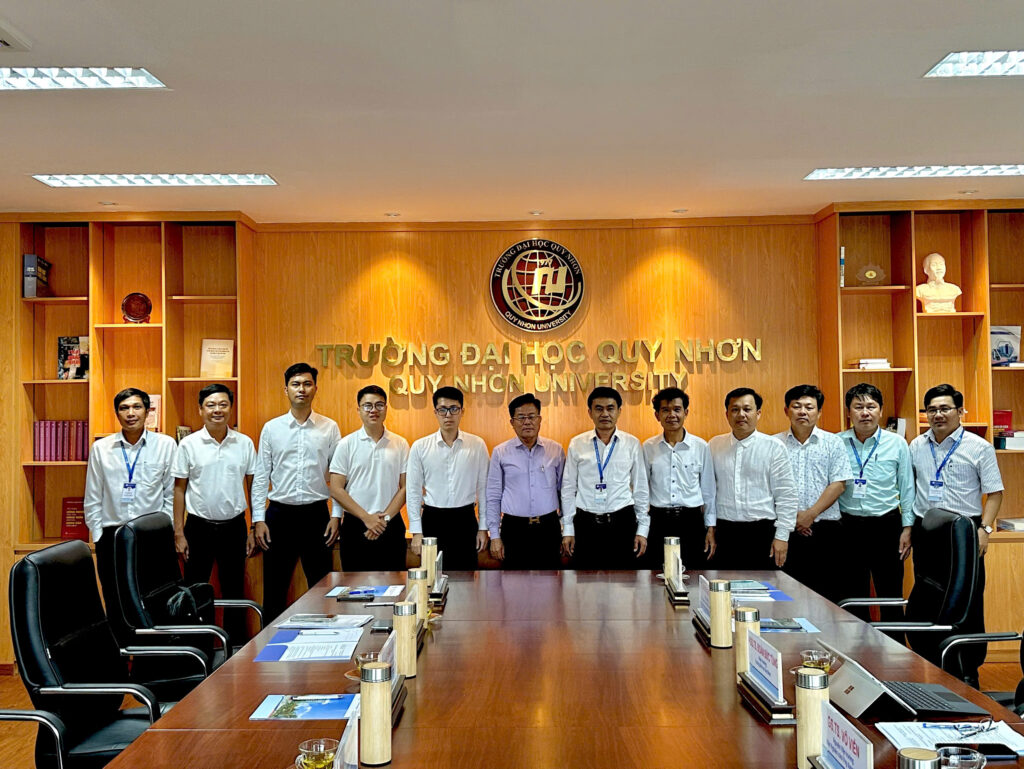
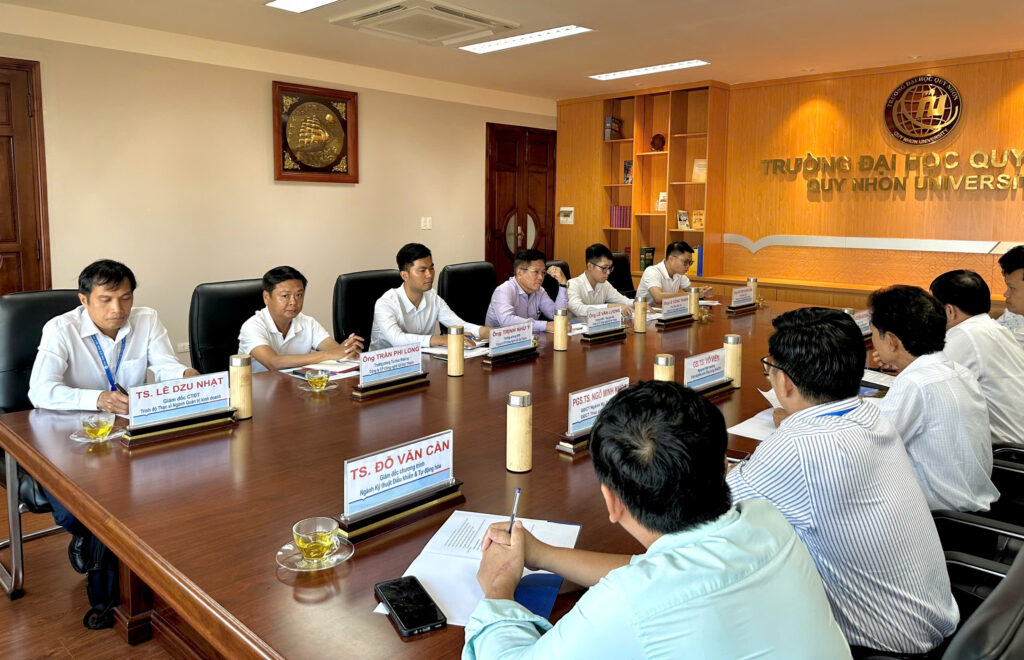
On the afternoon of April 1, 2026, a significant milestone in the roadmap for connecting technology and workforce supply–demand was established through a working session between the Institute for Applied Sciences and Technology – Quy Nhon University and Dai Thanh Furniture JSC. More than an amicable exchange, this was a constructive dialogue where academic thinking converged with the practical realitites of the digital economy.
Opening the session, Assoc. Prof. Dr. Doan Duc Tung – President of Quy Nhon University, affirmed that the University’s education philosophy is closely aligned with labor market. As one of the leading multidisciplinary education institutions, the University commit to providing high-quality academic resources to resolve challenges faced by local enterprises. He emphasized that collaboration with a large-scale company such as Dai Thanh Furniture JSC is an opportunity to transform knowledge from “the classroom” into value in production processes.
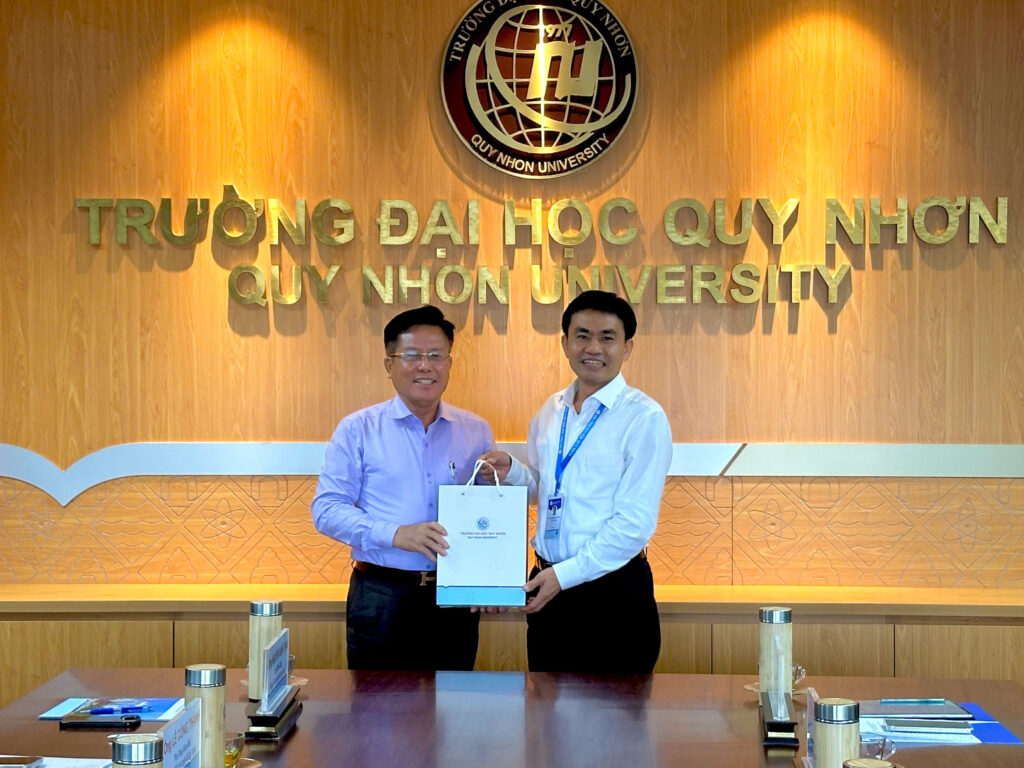
In parallel, the idea of developing customized training programs tailored to enterprise needs was proposed as a strategic direction. Beyond merely adjusting course content, this model aims to redesign graduate competency frameworks based on specific job roles, skill standards and practical operational requirements. Accordingly, the training process is no longer mass-oriented but evolves into a clearly structured value chain.
One of the solutions highlighted was embedding students into business environments through an immersive approach, rather than short-term internships. With sufficient duration and clearly defined roles across each stage of production, students can gain comprehensive exposure to the entire operational system – from technical production lines to management processes. It enables enterprises to proactively identify and develop suitable talent, rather than relying entirely on post-training recruitment.
From the enterprise perspective, Mr. Le Van Luong, representative of Dai Thanh Furniture JSC, shared candid insights into core operational and development processes. In an increasingly competitive landscape, enterprises not only respond to market pressures but also optimize their internal capabilities, particularly human resources and management systems.
He emphasized that the company’s priority need is not merely scaling up operations, but to enhance the quality of middle management which directly coordinates production and determining operational efficiency.
In addition to human resources, Mr. Luong emphasized the critical role of technology in enterprise restructuring. The implementation of an ERP system should not be limited to data digitization, but must advance toward capabilities in analytics, forecasting, and decision support. An effective system must be able to process data seamlessly across the entire value chain from production to management, enabling enterprises to better control costs, progress and quality.
He expressed his desire to establish a concrete, long-term collaboration program with the University, not only in workforce training but also in jointly developing technology solutions, particularly in management software and production automation. It’s a crucial foundation for enhancing competitiveness during the current transformation phase.
Mr. Trinh Nhu Y, Head of Dai Thanh Furinuture JSC ERP highlighted the importance of “data intelligence.” ERP and automation are viewed not merely as infrastructure investments, but as a process of restructuring enterprise data. Building a system capable of transforming raw data into actionable insights for management requires close collaboration between information technology expertise and a deep understanding of production operations. This also explains the growing demand for interdisciplinary talent.
In response to these expectations, experts from the University proposed breakthrough initiatives:
To personalize training programs, Prof. Dr. Vo Vien proposed a flexible collaboration mechanism under which the University designs training modules based on the Dai Thanh’s specific requirements in terms of required competencies and workforce scale. The University commits to supporting the enterprise in implementing management software solutions, scientific and technological improvements in production.
The Director of the Institute for Applied Sciences and Technology proposed an integrated solution, they will leverage its pool of engineering students with strong foundations, while collaborating with the Faculty of Finance–Banking and Business Administration to supplement managerial knowledge through short-term training programs. Based on practical assessments and the identification of specific enterprise needs, the Institute will develop tailored cooperation plans to ensure feasibility and effectiveness. This is a short-term training model aimed at developing “engineering managers” – professionals who are both technically proficient and highly competent in operations.
Dr. Do Van Can, Program Director of Control and Automation Engineering, stated that for software development needs, the University can fully collaborate with enterprises to develop systems tailored to specific requirements. Regarding workforce training, he proposed a model in which students undertake practical internships at enterprises for approximately 6 months, thereby enhancing their skills and professional capabilities. In addition, the Faculty can design specialized training programs for final-year students based on enterprise demand, with flexible scale and content. He emphasized that through real-world exposure, students will not only be able to operate machinery but also actively contribute to equipment selection, improvement and maintenance in line with production realities.
The meeting concluded with strong consensus on a comprehensive cooperation program. The Institute for Applied Science and Technology Research will serve as a “bridge,” coordinating efforts and closely assessing reality needs to develop the most feasible implementation roadmap.
The synergy between the intellectual of Quy Nhon University and the manufacturing capabilities of Dai Thanh not only promises to enhance enterprise productivity but also creates valuable opportunities for students – the future drivers of technological advancement. This stands as a vivid example of the academia–industry collaboration model, contributing to the sustainable economic development of the province. This also lays the foundation for the emergence of new collaboration models more flexible, more substantive and capable of adapting to the rapid changes of the modern industrial economy.